Write Romance? Get Your Beat Sheet Here!
NaNoWriMo (National Novel Writing Month—write a 50K word novel during November) starts today, and while I plan to continue blogging throughout NaNo, I wanted to make sure I gave you something good to keep you happy during my crazy month. *smile*
Of course, whether or not you’d define today’s post as anything good might depend on if you write romance or have romantic elements and love interests in your stories. For those who do, this post is a gift to you.
Last week, I ran a workshop called “Lost Your Pants? An Impatient Writer’s Guide to Plotting a Story.” I jokingly referred to it as my “plotting for pantsers” class, but it was really more about how to plan our stories at a high level to keep both our freaking-out inner editor and our diva muse happy.
The class was a great success, and I want to thank all my guinea pigs, er, students. The feedback I received from attendees made it sound like it was useful:
“Jami Gold is not only the master of structure and plotting spreadsheets, she’s also the master at taking all those books on craft and rolling them into a single, easy, cohesive plan.” — Melinda Collins
“I’ve taken a couple of webinars from Writer’s Digest previously, and this class compares favorably with them. In fact, I’d say that this one is my favorite of all the web-classes I’ve taken.” — Teresa Robeson
Wow. I’m rather speechless at all that. I’m already getting questions from others interested in taking this workshop too, so I have an informal “let me know when you’re offering this class again” sign up page.
But even as I was developing all the custom “pantser-friendly” tools for the class, I kept wanting to share my work with all of you. Ack! How could I provide something special to my students to make the class worthwhile and also do something for my readers. I like being helpful…on a near pathological level. *snicker*
Never Underestimate Romance Stories
So today I’m sharing one of the many tools I created for the class, and this one is especially for romance writers. Romance writers tend not to get as much respect as other authors. But developing a romance story is more complex than most recognize.
Romances are a different animal from other genres because their plotting and emotional interactions are complicated by two protagonists, such as a hero and heroine. (And let’s not even get into some of the variations, with multiple partners and whatnot.)
In a romance, we have the external (plot) arc, an internal (character) arc for each protagonist (such as a hero and heroine), and the Romance Arc—the growth of the relationship over the course of the story. That’s a lot of arcs and plot points to juggle on a standard beat sheet.
Introducing the Romance Planning Beat Sheet!
Ta-da! The Romance Planning Beat Sheet separates out the Romance Arc but follows the same structure as a normal beat sheet. It combines some of the beats from Blake Snyder’s Save the Cat and Larry Brooks’s Story Engineering and mixes in all the internal character arc stuff from Michael Hauge’s Six Stage Plot Structure as well as his teachings about using Identity and Essence for great love stories.
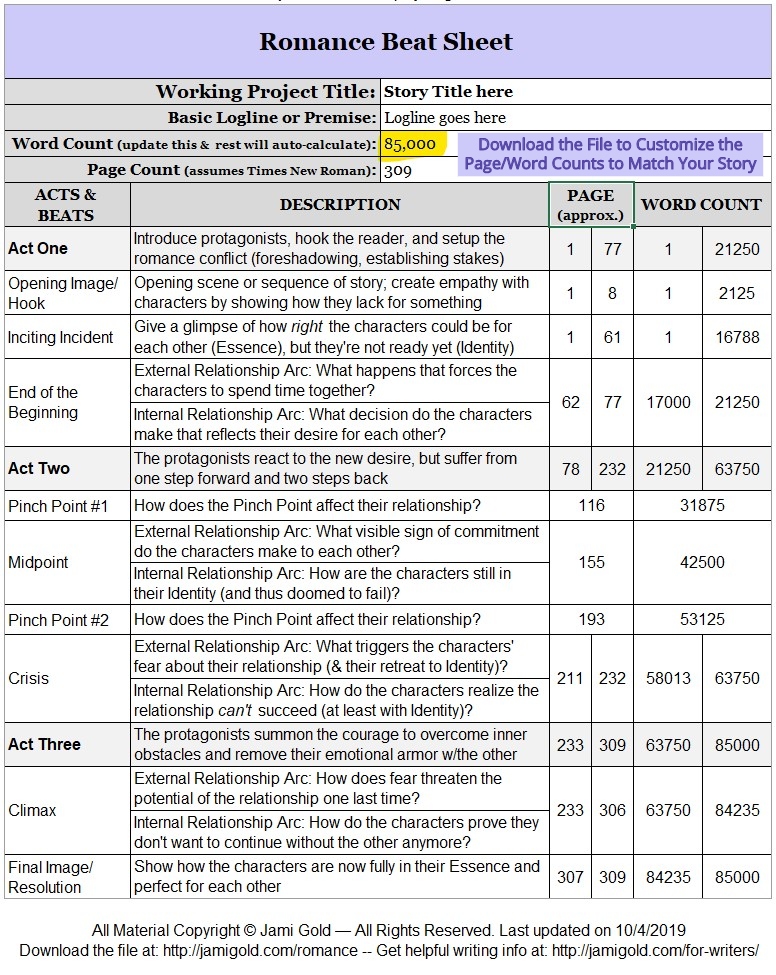
Click here to download the MS Excel ’07/’10 version (.xlsx) of the Romance Beat Sheet by Jami Gold
Click here to download the MS Excel 2003 version (.xls) of the Romance Beat Sheet by Jami Gold
By focusing strictly on the romance arc, and how the relationship develops between the characters, we can see our romance stories on a deeper level. As with the other beat sheets I’ve developed, if you input your approximate word count in the top section, all page count and word count marks will automatically update for each beat. Nifty-keeno, right?
UPDATE: Want help figuring out how to use this worksheet? My Between the Sheets workshop explains all the terminology, beat sheets 101, what should happen in our story with each of those boxes, and how we can use this Romance Beat Sheet to strengthen our story and deepen the romance arc.
Beat Sheet 101
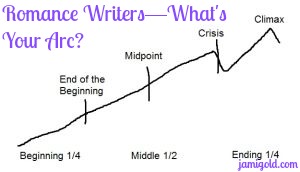
If you’re not familiar with some of the terms, Larry Brooks has a great explanation of an Inciting Incident, and he also introduced the concept of Pinch Points. The Inciting Incident (called Catalyst by Blake Snyder) is a life-changing/game-changing event that places the character on the path of the story. Pinch Points, one before the Midpoint and one after, are where the character sees additional evidence of the antagonistic forces. I love using Pinch Points to avoid “sagging middles.” *smile*
The names of the four main beats come from Martha Alderson’s The Plot Whisperer:
- End of the Beginning is also known as Break Into [Act] Two or the First Plot Point. This is when the character makes a “point of no return” choice, establishing goals, stakes, and obstacles for the story.
- The Midpoint marks another “point of no return” moment to raise the stakes. It can be a reversal (success to failure or vice versa), a false reversal (what seems to be a success is actually a failure), or a restatement/recommitment to the goals.
- The Crisis is also known as the Black Moment, All Is Lost, or Second Plot Point. This is where the character loses everything and symbolically dies.
- The Climax is also known as Finale. This is where the character is symbolically reborn and summons the courage and growth to overcome the obstacles and antagonistic forces.
But all of those descriptions are very plot oriented. They don’t bring in Michael Hauge’s concept of a character’s inner journey much less anything to do with the romance arc. If you’re not familiar with his concepts of Identity and Essence, check out this post for tips on how to show our characters’ internal journeys.
That’s why I wanted to create a companion beat sheet that would help us show how those plot points affect the protagonists in respect to their relationship. Do the obstacles bring them together? Break them apart? Provide an opportunity to work as a team?
Now we can tie that romance arc into the overall plot of the story and show the growth of each of the characters as individuals and as a couple. Romance writing isn’t for the weak. *grin*
Do you write romance or stories with romantic elements? How do you make sure the romance arc develops over the course of the story? Have you ever used a romance beat sheet before? Will this Romance Planning Beat Sheet be helpful to you? Do you have any suggestions for how to improve it?
P.S. Are you new to beat sheets? Check out my Beat Sheets 101 post, learn more about beats, and check out all my worksheets for writers here. And don’t miss my in-depth workshop focusing on how we can use this Romance Beat Sheet to strengthen our story and deepen our romance arc.
P.P.S. Write romance and use Scrivener? Don’t miss my Romance Scrivener template!
Pin It

Thank you so much for this useful Beat Sheet. It’s great that romance writers get some customized love 🙂 And this is useful for anyone who has a romance side plot.
Hi Reetta,
Yay for romance writers! 🙂 I hope it’s helpful for you. Thanks for the comment!
Oh, how I love thee 😉 Just what I wished for yesterday! And here it is. *pets screen*
Hi Charissa,
LOL! Yay! Just call me your fairy godsister. 😉 Thanks for the comment!
Thanks for this. I have an idea for a Regency/Victorian Romance series (it would span the bridge), and… Well, at least I can have this in hand for the day when I finally get around to writing it.
Or I could try it on my paranormal romance series, which I’m hoping to finish the first novella no later than January. Or I could just see how it applies to one of my other stories, because I often do have a romance arc in my speculative fiction.
(Usually, I don’t worry about it, because readers have told me I have a very good instinct for characters. And I’ve mentioned before that I let things build organically. I started A Fistful of Earth knowing that two characters would end up together, but I wasn’t sure how or why, and my subconscious did a good job with that, in my opinion. I’ve even consciously realized where book three is coming from—the MC goals, the MC emotional states, the overarching theme, etc.—so this should be easier to write than the previous book was. I hope.)
Still, romance isn’t the only genre that gets sneered at. The “softer” fantasy and science fiction tends to, as well, never mind space opera. *frowns and pats fun space opera stories* I’ll get to them one of these days, Lord willing.
Hi Carradee,
As a pantser, I generally don’t use beat sheets until revisions, but I like having the overview of the order and approximate word count of the beats to keep in the back of my mind while I’m drafting. 🙂 And you’re right about fantasy and softer scifi lacking in respect as well. *sigh*
I hope this comes in handy when you get around to writing those stories. 🙂 Thanks for the comment!
Thank you, Jami! I do write romance and I love the beat sheets you create. You always do such an awesome job. Happy NaNoWriMo. 🙂
Hi Christy,
Yay! I’m happy to help. 🙂 Happy NaNoWriMo to you too!
Awesome Beat Sheet, Jami! Thanks for that!
You’re welcome, Laura! 🙂
Jami, thanks so much for sharing this resource. I just finished an outline for a short story and I’m revising a novel, so I’ve been thinking a lot (I mean A LOT) about plot and “beats” lately. Many people don’t realize how many elements romance authors are juggling as they plot–character arcs for both the hero and heroine, the external plot, and the developing romance. Whew!
Hi Denise,
*whew* is it exactly. 🙂 Yay for romance writers! Thanks for the comment!
Jami, I love this romance beat sheet! I am currently writing my first historical romance and finding that it has some differences than straight historical fiction… aside from a lot more intimate scenes. This customized beat sheet will really help. Thank you so much for continuing to help writers.
Hi Haley,
Yep, add in that romance arc, and stories are a whole different animal. At the very least, you have a subplot to juggle (if it’s just “romantic elements”), and with a full romance story, the romance arc matches the story arc. As a story structure geek, I find this stuff fascinating. 🙂 Good luck with your new story and thanks for the comment!
What a great writing tool! As always, thanks for putting out such a super blog post.
All my best 🙂
You’re welcome, Gina. 🙂 I’m happy to help!
I try to write romance in my stories; I don’t think I do well at it. This will certainly help.
Good luck with NaNo.
…….dhole
Hi Donna,
It’s sometimes hard to tell whether we’re creating “chemistry,” especially when we first start out. I never know whether my hero is “hot” when I’m writing. Beta readers are great for that kind of feedback. 🙂 Good luck and thanks for the comment!
I was so fortunate to take your class!! I’ve used the beat sheet over the last week, implementing your teachings, and it’s been working great for me.
Now, because of your generosity, others will benefit from your wisdom as well.
Thank you for being you!!
have a great evening and GO NaNo!!!
Tamara
Hi Tamara,
Yay! I’m so glad the workshop tools have been working for you. *hugs* Thanks for the comment! 🙂
Love the beat sheet! I’ll let more know!
Thanks 🙂
Hi Avery,
Thanks for spreading the word and for the comment! 🙂
This is brilliant. So very very helpful! Thank you so much for your wonderfully inspiring blog posts. xxx
Hi Edith,
*blush* Thank you. 🙂 I’m happy to help!
Perfect timing, Jami. I’ve been stewing over the romance arc in my current WIP. I just revised the love scene today. I’m happy with the dialogue and internal narrative there but still wonder if I’ve developed the character arc of one of the protagonists well enough in the preceding chapters to make the placement of the love scene believable. Your cheat sheet is going to help me go through the earlier chapters and make certain it works!
Hi Char,
Ooo, that does sound like a great application for this beat sheet. I hope it helps. 🙂 Thanks for the comment!
This is a great cheat sheet, Jami! I downloaded it, plugged in my info and printed it out. So when I get stuck as I’m doing NaNo, I’ll have this handy-dandy reference to kickstart my muse again.
I know you’re using Scrivener. Did you plug in some of this there to help keep you on track?
Hi Laurie,
So far, I’m just using Scrivener for drafting. I haven’t copied in all my research or notes or anything beyond trying to mark word count targets for beats.
I hope you find this beat sheet helpful. 🙂 Thanks for the comment!
[…] Jami Gold: Write Romance? Get Your Beat Sheet Here – NaNo Prep: What Writing Tools Do You […]
Woah–This beat sheet is the shiz-nit.
And I’m just happy to see that someone else out there are as OCD as I am.
Hi E.B.,
LOL! Hmm, where is the line between OCD and perfectionist? No, wait, maybe I don’t want to know. 😉
I hope this help you. 🙂 Thanks for the comment!
[…] hint of magic and beauty with this post from Bealtaine Cottage. Romancing the book: Jami Gold offers a beat sheet for writing romance. Balancing the scenes: Kristen Lamb continues her series about structure with a discussion of scene. […]
Thanks, Jami. I don’t write romance, but it’s still good to see beat sheets like this for different genres. Makes it easier to get my head wrapped around the whole concept. I’ve read both Blake Snyder and Larry Brooks books (loved them), but haven’t tried Michael Hauge’s stuff yet.
Hi ChemistKen,
Good point! Sometimes just seeing the same beats from a different perspective can help us better understand what’s supposed to happen at that point. 🙂 Thanks for the comment!
Hi Jami. Very interesting post.
I adore Excel sheets :). So thank you very much for the sheet you provided. It looks great and very helpful. For “plotters” too.
Hi Irene,
LOL! Very true about how plotters and pantsers can both use beat sheets. I had one non-pantser in my workshop, and she got just as much out of the class as everyone else. 🙂 Thanks for the comment!
OH thankyouthankyouthankyou!! Your spreadsheets help me so much! I was really hoping you’d do one like this for romance.
I write contemporary romance. I had most of these elements in my story, but the timing was all out of whack. Rewriting, rewriting, and rewriting some more.
Hi Laurie,
I’m happy to help out my fellow romance writers. 🙂 Thanks for the comment!
Thanks you so much for the resources. This is great!
Hi Elizabeth,
I hope it’s helpful for you. 🙂 Thanks for the comment!
[…] Jami Gold’s blog offers numerous ‘cheat sheets’. Start here. […]
Hi Jami, I’m currently revising the structure of my story and I’m struggling with the link of external and romance arc. If the story is Romance, what do you use as a base for structuring your story, is it the external plot or the romance plot? I mean, do you structure the external plot first, and inject romance to follow the external? Or do you plot the romance first and then build the external events around that arc? If someone asks what is my First Plot Point, should I say: it’s when the hero gets a mission to kill the bad guy, or should I say: it’s when the hero and heroine agree to start a romantic relationship? Also, the stakes of external and relationship arc are usually different. If the external arc is about destroying a terrorist organization, then the pinch point is when they terrorize people (to remind the readers that there are lives at stakes here). But if the external plot is a backdrop for a love story, then I think the real stake should be the relationship itself, and the pinch points should be the events that threaten to break the relationship, right? Does this mean that I have to make the hero & heroine start their relationship at the same time when the hero gets the mission? Or that I have to make the terrorists kill people while the heroine is in some sort of hostage situation (or even have the bad guys beat up… — Read More »
Hi Eve, That’s a great question–or questions, actually! If you’re not already familiar with basic story structure, you might want to look into the Save the Cat, Story Engineering, or Plot Whisperer books mentioned above. (Or you can sign up for my next workshop. 😉 ) The answers might be different for every story, so let me tell you what I’d look at to decide how I’d describe a story to someone: – Which plot arc make the story unique? Often the romance might be a simple “boy wants girl, boy loses girl, boy wins girl” plot line, while the external plot adds the unique twist. Sometimes it’s the other way around. Or even the internal arcs of the characters. But something makes this not be a generic story. – Which plot arc drives the story forward? Often the external plot drives the beginning of the story (forcing the characters together) and the end of the story (fighting the antagonist). But the middle of the story might have different drivers. Maybe this is when the romance takes on a life of its own. In other words, there’s no wrong answer about how you’d describe a story to someone else, and that doesn’t have to line up with what you’d put on the beat sheet. 🙂 Some of my beats are more external and some are more internal or romance plot oriented. It’s okay to mix these. For me (speaking as a pantser), I fill out beat sheets to a very… — Read More »
[…] do this, too. What Type of Writer are You from Philip Overby – i am a combo of all of these Write Romance? Get Your Beat Sheet Here! from Jami Gold – for the organized romance writer Post Inspired by our Great Writers […]
So awesome, I have to share.
Thanks, Charmaine! I hope people find it useful. 🙂