A recent article about unlikable heroines pointed out that likability is often more of a problem for female characters than for male characters. While I’ve learned how to minimize those issues with my characters, the problem still rankles me.
Pin It
Read More
We’ve probably all heard (or thought!) that description is boring or the part readers skip. Yet our stories need description or else be confusing. Marcy Kennedy joins us today to share 5 tips to empower and add interest to our description by using contrast.
Pin It
Read More
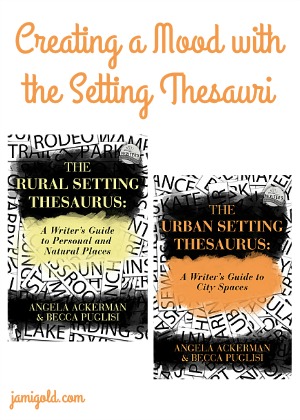
The Thesaurus books by Angela Ackerman and Becca Puglisi are a must-have for every fiction author, and they now have two new Thesauri books: Urban Setting and Rural Setting. Becca’s here today to talk about how setting is important for more than just describing the time and place of our scene.
Pin It
Read More
The learning curve we face when deciding to become a writer is always longer than we think because we don’t know what all we don’t know. So how can we track our progress? How can we tell whether we’re improving? How can we feel good about our writing?
Pin It
Read More
As writers, we do everything we can to make readers invested in our characters in some way. An invested reader is a happy reader, right?
Well, maybe not. Let’s take a look at the other side of character development.
Pin It
Read More
Ashley asked a question in the comments last week that gets at the heart of strong, proactive characters. Even in literary fiction, characters are usually faced with making choices, and whatever triggers those choices is where we’ll find plot and character agency.
Pin It
Read More
Our characters have to overcome many obstacles throughout our plot, but changing the obstacles doesn’t always fix story problems. Sure, sometimes an obstacle doesn’t fit the story, but too often, the obstacle itself isn’t what’s broken—it’s the storytelling around the obstacle.
Pin It
Read More
When we first start off as writers, if someone asks us about our story, we might launch into an overview of our story’s plot. It’s easy to think the plot is what our story is about. But with few exceptions, story isn’t the same as plot.
Pin It
Read More
I’ve written many times about how much I love subtext, the stuff that happens between the lines. Subtext lurks in many aspects of our stories and helps immerse readers and add realism and tension. In addition, subtext can help us build layered characters.
Pin It
Read More
To create a great emotional story, we need to know not only the vocabulary of describing emotions, but also how we can evoke emotions in our readers. Marcy Kennedy’s here to show us how deep point of view can help us evoke those emotions we want within our readers.
Pin It
Read More