Self-Publishing: Prioritizing Fast, Cheap, and Good
All writers, especially those who self-publish, have to decide: Are we writing and publishing just for ourselves? Or are we writing and publishing to get customers (readers)?
If we’re doing it for ourselves, things like editing and those nice covers we talked about last time don’t matter. Those who write for themselves can self-publish with zero expectations of anyone else discovering or enjoying their work.
Maybe they just want to see their name on Amazon. Maybe they simply want to print a couple for friends and family. Maybe they figure, “what the heck, let’s see if anyone else cares.”
If We Expect Customers, We Must Expect to Invest in Our Business
Those are all fine reasons for self-publishing our work without worrying about editing or cover art or formatting, etc. But as soon as we expect people to hand over their money, we have to convince them we’ll make it worth their while and then fulfill that promise.
In short, we have to reach customers and keep them happy, just like any other business. And like most businesses, self-publishing businesses can struggle to get off the ground.
Whether we’re opening a restaurant or self-publishing our work, we have to be willing to invest in our business. Wanting to sell books rather than restaurant meals doesn’t make the laws of business not apply to us. Others who start businesses either save or find investors or barter for services. We should expect to do the same.
Have We Been Spoiled by the Ease of Self-Publishing?
If we look at the history of self-publishing, we have it easy now. Until the last few years, someone who wanted to self-publish their book would have to invest in print copies and have almost zero chance of ever selling their book in a store.
A friend of my brother’s went this route over ten years ago. He paid to have a professional design, printed up a thousand copies (now that’s expensive), and drove across the state from store to store, asking them to stock his book.
He was lucky. Because it was a non-fiction book that met a need, all that work actually led to success. If not for that fact, virtually no amount of effort would have been enough.
Now we don’t have to invest in print or rack up miles to sell our book in an online store. Have we become spoiled by ebooks, print on demand, and Amazon? Do we expect that because those printing and stocking aspects now cost nothing, that we should be able to self-publish without any upfront money?
What If We Have the Will but No Money?
I know the money issue is a tough one for many of us. Taurean Watkins and I have had many conversations in the comments here about will versus money, and I feel for his situation. My family still hasn’t recovered from the job loss I wrote about a year ago today. So I don’t bring this up to be heartless by any means.
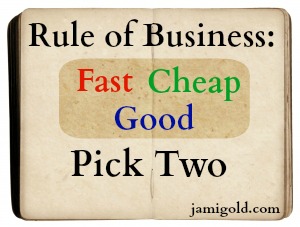
Instead, I want us to share ideas about how we can treat our writing as business even when we’re hurting for funds. These will take compromise on our part. There’s a business saying: “Fast. Cheap. Good. Pick Two.”
- If we want something Fast and Cheap, it probably won’t be good. If we’re impatient and just want to start making money, this is a valid option. But we’d need to compromise on quality (possibly with the goal of updating to a better cover, editing, or formatting later, after money comes in).
- If we want something Fast and Good, it probably won’t be cheap. If we’re impatient and demand quality, this is a valid option. But we’d need to compromise on cost. In other words, this is the “money is no object” option.
- If we want something Cheap and Good, it probably won’t be fast. If we demand quality and cheap prices, this is a valid option. But we’d need to compromise by being patient, as this choice would require extra time and effort.
I’ve already stated that the first option—compromising on quality—is a valid option, depending on our goals. There are risks with that method. All those “you never get a second chance to make a first impression” truisms are well-known for a reason. But if we had money for only one thing—like editing—I think compromising on book cover quality wouldn’t be the end of the world.
However, I want to look closer at that last option. If we’re willing to be patient and put in extra effort, we might be able to cheaply launch our writing business with good products. Here are some ideas for how we can use time and/or effort to reach that goal:
- Collect several excellent critique partners and/or beta readers to help with editing.
- Search for freelance editors who give discounts on “clean” manuscripts (and then ask for a sample edit to ensure your manuscript is as clean as you believe).
- Watch for contests with manuscript edits as prizes (occasionally offered by agents and editors, as well as by multi-published authors).
- Learn PhotoShop and make our own covers.
- Learn about typesetting, interior design, and ebook formats to create our own files.
- Trade our services with those of skilled friends.
- Ask for favors, like friends & family discounts, from our skilled friends.
- Contact emerging talent (high school art students, etc.) who might work for less money.
- Contact skilled people who might enjoy supporting an author (high school English teacher, etc.).
- Exchange services for “advertising,” like a promotional blog post.
- Beg friends and family to invest in our success.
- Utilize Kickstarter to raise funds (CreateSpace’s five free paperback copies to NaNoWriMo winners could be used as incentives).
Of course, querying and pitching in an attempt to gain a traditional publisher is one way to avoid all this hassle. But due to changing market conditions, genre trends, etc., the traditional publishing route is essentially that same “cheap and good, but not fast” situation.
No matter how we decide to publish, we still need to prioritize among these choices. So far, I’m definitely not on the “fast” path. *smile*
Do you have additional ideas for how we can save money when starting up our writing business? Are you writing/publishing for yourself or to gain readers? Do you think self-published authors are spoiled now and expect something for nothing? When and how would you be willing to compromise on quality? How do you prioritize “fast, cheap, good”?
Pin It
I’ve chosen the Cheap & Good route for my business. I’m blessed to have many years experience as a graphic artist, then as a web developer, so formatting, print book design, and cover art are easy for me. But they still take time, and I barter these services to writer friends for beta reads and editing, which takes more time too. But so far it’s working for me.
Hi Jennette,
Yay! I’m glad it’s working for you. 🙂 And thanks for letting us know that the barter system really does work! Thanks for the comment!
Hi Jami, GREAT topic! Well-timed and extremely informational. 😉 I actually can’t think of any other ideas that’ll help authors save money with this process. It’s definitely time consuming and costly, but as we’ve pointed out, it’s a business, especially if we’re seeking a readership. I think another good idea for authors who are going to attach self-publishing is to create an actual business plan for themselves. I’m a huge advocate of business plans. Coming from the corporate world, I’ve seen it proven time and time again as a valuable road map to success. And business plans don’t have to outline what’s going to *right now* – instead they can outline a ten-year SMART goal plan, then we can take the larger goals and break them down into smaller, obtainable goals… like learning PhotoShop, making network connections with freelance editors and graphic designers and the like. If I were to decide on self-publishing, that’d be my first step in the journey, and I’d totally barter a month’s worth of babysitting for my sister-in-law in exchange for an awesome cover (she’s a graphic artist). But until then, I’m going to enjoy my niece/nephew free nights and keep trucking along the traditional publishing dream track. 🙂 I don’t necessarily think that self-published authors are necessarily spoiled. I think that because it’s non-traditional and you’re doing the entire process on your own, that it’s hard to get *good* and *right* information on the how’s and why’s of the self-publishing process. So maybe not… — Read More »
Hi Melinda,
Great point about coming up with a business plan. Susan Spann has written several great articles about developing author business plans over at the Writers in the Storm blog.
I know when I first started, I decided against doing several things because silly me assumed all this would happen a lot faster. 🙂 If I’d known then how long this would take, I’d have kicked off several more projects long ago. LOL!
So I completely agree with you about how the long term plan is a great idea. If we’re not looking at only the next step, we can decide what we want to do beyond this one project. 🙂 Thanks for the comment!
My family changed internet plans so I was offline for some time. Thanks for going out of your comfort zone to do this post, Jami. I will be directing any writer here (My post on the subject will be out next week) who need to see this from more than one side. The only thing I take issue with in your post above is comparing starting a restaurant to successfully self-publishing for readers (as opposed to for hobby or niche reasons) because they’re not as interchangeable as you mean them to be. Restaurants need approval from city zoning boards, health inspections, food safety regulations, of course competing establishments in the area, a combination of self-promotion and eventual word of mouth, and so much MORE! This is another reason why I’ve hesitated pursuing my previous dream to be a chef, it requires more than knowing how to cook, it requires business skills and finances (I’d want to have my own restaurant/bakery at some point, note I didn’t say exactly when…) I just don’t have. Yes, self-publishing is a business, too. But it’s NOT the same kind of business, Jami. That’s all I’m getting at. Self-publishing doesn’t have the same kinds of demands a restaurant does (Have you not seen Restaurant Impossible, Mystery Diners or Chef Wanted Food Network or shows on other networks like Hell’s Kitchen and Top Chef?) there’s more to juggle than just creating great food. Though, as you rightly point out, there’s WAY more to (Non-hobby) self-publishing than… — Read More »
Hi Taurean, Of course no analogy is ever perfect. 🙂 You’re right that there’s more to running a restaurant than just great food, just as there’s more to running our writing as a business than just great writing. But on the level of business sense, all businesses have commonalities, and that’s the only point I was trying to make there. Some writers (not you) get caught in the trap of thinking all they need is writing skills to succeed. While that might be possible with traditional publishing, that’s not the case with self-publishing. Yes, we feel “called” to write, but that doesn’t mean self-publishing isn’t a business with all the same requirements of other businesses. (To anyone else reading this comment and worrying, I wrote a post a while back about how those writers without business sense could still succeed.) I understand what you mean about it being hard to wait indefinitely on faith. In fact, in this regard, the waiting forever for finances or assistance or whatever to line up better might fall into the same issue as revising forever. When we revise, we sometimes have to force ourselves to stop worrying, because there will always be something to change, to tweak. We have to draw a line and say that this is the best we can do at this point in our skills. Period. Perhaps a similar line would be good to cut off our perfectionism about being able to afford the “perfect” editing or the “perfect” cover.… — Read More »
I can’t help but ask-
How is what you just said above not contradicting what you said in today’s and yesterday’s post about making a great first impression? It feels like it does.
How can you be nonchalant but care? Sorry if I sound mad, I’m not, I just feel more confused than ever…
Hi Taurean, Life is not black and white, and compromises are inevitable. So while we want to make a good impression, that doesn’t mean we necessarily have control over making something “perfect.” This acceptance of reality isn’t being nonchalant, and it’s not that we don’t care. However, we perfectionists can hurt ourselves if we hold off indefinitely for “perfect.” Like I said, I compare this to editing, and how I could easily never let myself be done with something. However, at some point, we have to accept that it’s as perfect as we can make it at this point in time. So settling for a less than perfect cover doesn’t mean we don’t care, but it’s just recognizing that reality has a nasty habit of making perfect impossible. 🙂 All we can do is make it as perfect as we can, given our circumstances at this point in time. Is that risky? First impression and all that? Absolutely. But if the alternative is to never release it because we don’t have the money to get the cover we really want, only our personal goals will reveal which option is better. Some might think that nothing is better than something, or they might be okay with that endless indefinite waiting. Others would think something is better than nothing. I bring this up because if the endless indefinite waiting is driving us crazy, we might need a reminder that “perfect enough” is a valid option too. 🙂 So if we have a… — Read More »
I wish that made me not want to cry. Not your fault, Jami. No one’s fault, really. It’s simply the downside to being emotional. I still feel your being contradictory, but I finally have to accept it’s my personally being tired of waiting and learning with little to show for it. As much you warn about the revision trap, I could not escape the revision I had to do, and trying to self-publish any sooner would just not be something I’d be proud to have my name on. How do you begin to define compromise versus selling out? Even after reading Anna’s story, I only feel more shame and confusion. Again, not your fault, it’s just what I’m feeling now. I’ve worked too hard and endured too much to quit. I don’t want to quit, and I don’t want to take another break, Jami. I spent most of last year on BREAK. That’s not what I want anymore. I want to be making things happen. I don’t know how you do it, Jami. It’s hard to believe how much we have in common, yet your in a far different place than I am, and I know it’s not easier, but it’s hard to feel stuck where you don’t belong, you don’t have to be trapped in a bad marriage with 4.5 kids to feel that way. I wish more folks over 30 would understand that. If not for the internet, despite it’s drawbacks, I might not otherwise knew people like… — Read More »
Hi Taurean, I certainly don’t mean to be depressing. 🙂 I want to repeat what I said in the last paragraph: “we have to look at our long-term goals and figure out if we have a plan for reaching them…” That’s important for writing, publishing, and life. It’s okay if our plan requires 50 steps to get there. Each step we complete can still give us a sense of accomplishment. Every time I struggled with revision, I tried to come up with a plan to learn the knowledge I was missing (how do I show deeper emotion? etc.). The only time I felt despair and an “I can’t do this” attitude was when I didn’t know how to get from point A to point B and I had no ideas for how to make that journey. If we have a plan, those revisions aren’t a waste, and any waiting game isn’t a waste. I was referring more to the kind of revisions where we go in circles because nothing is technically “wrong” or to waiting games where “we can’t get there from here.” So compromise means settling for something that isn’t wrong and just isn’t as right as we’d like for it to be–when we can’t see a way to make it more right. No plan means no action and leads to frustration unless we find another way to make progress through compromise. Selling out means saying something is good enough even though it is wrong and we can see… — Read More »
The more work I produce the more I’m having to go outside my beta readers and favors from super talented friends. I’ve been lucky, but there’s only so much I can barter or beg.
I plan on paying for editing for my next book and I already pay for formatting on my longer novels, as well as cover work. Admittedly I get a great deal from a friend in the business.
It’s hard though, because I agree that you have to invest in your business to make a profit but releasing books is a risky business still. There is no guarantee of success or sales.
Hi Angel,
I hear you. We don’t want to impose on people either. My best advice for that is to make sure that we’re giving back to them in some way.
Every publisher out there (self or traditional) would give you a big thumbs up to your risky statement. That’s the nature of most start-up businesses. Most restaurants (or internet companies or whatever other example we choose) fail too. We need to have a certain amount of passion and feeling that we’ve been “called” to this work to take that risk, I think. 🙂 Thanks for the comment!
[…] Self-Publishing: Prioritizing Fast, Cheap and Good by Jami Gold […]
You are so full of wisdom!
Great post. 🙂
Hi Melissa,
I’m full of something anyway. LOL! Thanks for the comment! 🙂
Hi Jami,
I was very fortunate because my critique partner, was not only a copy editor, but she has been doing graphic design, so I have been fortunate to have the best of both worlds.
Most self published authors should also remember that since the rise in self published e-books there are graphic artists who will charge you more than what you are willing to pay for what you think is reasonable for their services. One designer I was consulting for a bulk of 4 e-book covers only was going to charge me $1500 for just 4 e-book covers. My friend said that since I was only asking for the e-book covers it should not be that expensive and I went looking around for another service.
Thanks for letting me comment.
Hi Vanessa,
Lucky you! 🙂 Yes, part of having business sense means looking around until we find someone we can afford. With the Wild West aspect of self-publishing, prices are all over the map, and the cost doesn’t always line up with quality. I’ve seen some cover artists charge much cheaper than they could and some charge much more than they should. 🙂 Thanks for the comment!
Fast, Good, and Cheap is a great way of looking at this subject. Sadly, I’ve tried to do all three combined with the end result of less hair and pounding headache of frustration. Personally, I think the Fast aspect was the worst for me – I like to know where I’m going, choose words for precision (much like I speak) and fast is not friendly to that style of writing. Thanks to this post and one by Jane Friedman, I’ll be focusing on Good and Cheap moving forward. Excellent money-saving suggestions. The hardest part for me has been in finding a critique partner and to some extent beta readers that are not family. Yes, I love my “family,” but I also know that their opinions are tempered. I am definitely writing to gain readers. While writing is a fun activity, I see it as a business and would one day like it to be my full time paid occupation. In a way, this thought was an obstacle for a long time, mainly due to be a perfectionist professionally. Nothing is ever perfect (the hardest lesson to learn) and allowing the idea that it can proved a detriment. Fortunately, I have many friends that have taught me a different thought *smile* Has self-publishing spoiled some authors? Yes, without a doubt. It has also made some cagey and driven others to throw aside basic logic and ethics – all of which saddens me because of the impact it has on how the… — Read More »
Hi Gene,
Yes, finding good beta readers can be a challenge, especially in certain genres. I have another post in mind to link to various resources for finding them, but that’s a research-intensive post, so I’ve been putting it off. 🙂
Like you, I’m having to learn where my perfectionism helps and where it doesn’t. As I replied to Taurean, the search for the “perfect” editor or the “perfect” cover artist might be another one of those places where perfectionism holds us back. Just like when we’re editing and have to force ourselves to stop somewhere and just accept that it’s the best we can do, we might need to do the same with some aspects of publishing. 🙂 Thanks for the comment!
I’m going the cheap good route too. Only option for me at the moment! I did pay for editing, since it’s the one thing I needed help with. I have people who could comment on the grammar/sentence structure for me, but paying someone to look at the overall story has been really helpful. I shopped around though, added editors to my twitter/facebook pages, and managed to catch one on a deal, and another on a starting offer. Despite this, the editing stage has taken WAY longer than I thought it would.
I’m lucky to already have photoshop for my day job, and a sister who’s an excellent graphic artist, so that one was cheap and fast for me. Hopefully still good though!
I’m up to formatting now. Trying to learn it myself, since I don’t know anyone who does it, and I’m unwilling to pay for it, since it seems like it should be easy. The trickiest bit I’m finding is finding good information on how to do it.
Hi Rinelle,
LOL! Yes, everything has taken me way longer than I thought it would. 🙂
Good for you on knowing PhotoShop! As for formatting, I agree. The Book Designer has several good articles, but it seems like Amazon, Smashwords, etc. all change requirements and make you start over frequently too. *sigh* Thanks for the comment!
“Collect several excellent critique partners and/or beta readers to help with editing.” So, so would love to hear how/where others are garnering critique partners/beta readers!
Hi Morgyn,
I’m slowly making note of various resources for this and will share in a new post when I’m able. 🙂 Thanks for the comment!
As you already know, I’m publishing just for myself and not to make money. I simply want the satisfaction of seeing a physical book in front of me, all neat and pretty (so I have high demands on the loveliness of the cover). But at the same time, I do want to share my published books with my friends too. 🙂
Not a very useful comment, I’m afraid, haha.
Hi Serena,
LOL! I totally understand about wanting a lovely cover no matter the reason for publishing. I love pretty covers. 🙂 Thanks for the comment!
As you know I’m not looking to self-publish. I’m going another route, but I have loads of friends who are passionate about SP. Some of them are trying very hard to do things right, get their stories out there, make a name for themselves. Still others are using SP as a way to get a book that has been rejected over and over again and isn’t really ready for reader’s eyes out on hypothetical shelves. In this way, I definitely think that self-publishing is getting too easy. I know you’re discussing the money aspect of SP, and I think this post is necessary in its wisdom, but I also think that the ease of publishing ones own work these days is diluting the sea of truly talented authors. I have a friend that reads daily. She blows through three novels a week. Pretty impressinve, but over the last year she’s complained that it’s harder and harder to find really good books online. She says she’ll read ten/twenty samples a week, trying to find something worth while and might choose one or two books out of that grouping. She sees grammatical errors, illogical plots, weak characters. She said it’s frustrating and a little disheartening. Granted, everything’s subjective. She’s a hard reader to please, but I wonder if the ease of self-publication and the resulting issues with some of those under-edited books will, overtime, turn some die-hard readers away. It’s something to think about. I’ve been away for a while, trying to… — Read More »
Hi Tamara,
Yes, there are some self-published authors who push themselves and their skills and some who are looking for the easy way out. I’m blessed here to have such wonderful commenters that I know more of the former than the latter. 🙂 Thanks for the comment!
Dear Jami, In the race between the hare and the tortoise, I hope this tortoise wins. It’s been slow as I seek quality in my writing. I don’t think it’s striving for perfectionism that’s holding me back exactly, so much as trying to reach a level of quality that evades me. This January, I decided not to write another word of the non-fiction book I’ve been working on, until I have an organized plan and direction. Searching the web for tips and helps on how to do that is what brought me to your website. Self publishing is not my goal. So how do I get from a large stack of writings and interviews and infinite decisions to be made, to a readable, publishable book? This eleven year old project began with beginner writing classes and then as many writing courses as I could: fiction, non-fiction, memoir writing, poetry, playwriting, etc. Then I wrote and wrote, like a scratched CD plays, the same themes and stories repeating, different, but not improving. One writer said, “Don’t worry, you’re doing études. Writing like learning to play an instrument requires practice.” To me it’s been a slow, slow, slow, but exciting slog! Études later I’m considering professional help. It’s like moving from building a dog house in the back yard to building a house. I don’t know what to do now, or how to do it. I don’t want to write more without knowing where I’m going. Someone recently mentioned that I need… — Read More »
Hi Sylvia,
Great question! I know the structure of fiction stories inside and out, but I’m not an expert in non-fiction in the slightest. 🙂
I suspect there are a multitude of ways to organize non-fiction information, everything from a big picture that narrows down to a series of essays. That’s probably the reason you’re stuck. You have too many choices. 🙂
But if you step back, you might see that some structures work better with different messages or themes. Will people not understand the details until the see the context of the big picture? Or will the thread of commonality between essays make the point? Etc., etc. So maybe see if you can summarize in a sentence or two what understanding you want people to come away with, and see if that helps you decide on a direction for the structure. Have you read any writing books that go into these different types of non-fiction structures so you know what your choices are?
If that doesn’t help you see the problem from a clearer point of view, then a non-fiction content and/or development editor might be able to help. There are different kinds of editors: content/development, line editor, copy editor, and proofreader. You’d want one of that first kind who specialized in non-fiction. Some writing forums or other sites might have a way for people to recommend freelance editors.
I hope that helps! 🙂 Thanks for the comment!
[…] Gold: Self-Publishing: Prioritizing Fast, Cheap, and Good. Excerpt: “All writers, especially those who self-publish, have to decide: Are we writing and […]
Hi again, Jami. Just wanted to say thanks for hearing me out. I am getting ideas of what I can do. I’m still overwhelmed, but I’ll be okay. I’ve faced this frustration before and survived, it’s just hard not knowing what to do.
I think I would’ve the DIY thing last year if I hadn’t been rattled about the “Professional first impression” thing. When you’ve been conditioned to ALWAYS be on your A game, it’s hard to in effect, lower your expectations. Just because I had to make concessions as the writer, doesn’t mean it will not matter to the readers I want to have.
I don’t consider myself a perfectionist like you do, Jami. Like I said, I personally couldn’t avoid the long revision process my last book needed, but I get the danger of not moving on, okay?
Sure, I personally want the highest quality possible, but blame some of my intensity on this issue comes in part from all the market guides and podcasts I use as resources that preach fiercely about needing nice cover and freelance editors.
So if seemed overly obsessed about presentation, know it’s NOT all coming solely from me.
Still, thanks for hearing me out.
I hope if nothing else more writers reading this post and comments will realize just because some writers can’t afford a certain level of quality, it doesn’t always mean we’re trying to screw readers over with sloppy books all around.
Hi Taurean,
I hear you. Good luck with those ideas! 🙂
When you need to save money, I also find it helpful to allow yourself to screw up. Case in point: If you want to learn to design your own covers. Your first few, in the very least, will be off the mark. I’m learning (rather quickly, considering how few covers I’ve done) how to produce covers that make my fans go “Ooo!” even if they make other people go “Ulgh!” Because frankly, your covers need to attract your target audience. (I personally also want it to appeal to me.) And then there’s nothing wrong with changing the cover every so often, if that’s what you want to do. For example, I love having color bars behind the text, and I ideally want both readable in the thumbnail. I also want the story title before the author name (I get so annoyed by covers wherein I have to puzzle out which line is the title, which is the series, and which is the author name.) But I’m well aware that those things are personal preferences that some folks dislike. That’s okay. It’s okay for a cover to flunk for folks who aren’t in your target audience—and it’s okay for a cover to flunk for folks in your target audience. You can always try again. Unless you make a complete @$$ of yourself, folks are unlikely to remember your screwups for long—and frankly, folks in general are unlikely to remember your explicit screwups, regardless. (James Frey is a major example. I’ve also… — Read More »
Hi Carradee,
Excellent point! Yes, we have to be able to tune out those who don’t like our covers because of personal preferences that have nothing to do with our target audience. And you’re absolutely right about how people won’t remember bad covers down the line.
If someone buys our books and discovers the editing is bad, they’ll likely remember us because they won’t want to waste their money again. However, if our cover is bad, people will just ignore us. They’re not going to be upset about spending money because they’d just passed by our book before. Then when we update to a new, better cover, we get to start from scratch. The vast majority of people won’t remember the old one, so the black mark for covers is very faint compared to the black mark for editing. Thanks for the comment!
Even with the editing, I believe folks will forget, given time, though it’ll likely take longer than the cover, particularly if you fix the problem. (Because then, when they spot your blurb, your excerpt, they will be seeing the nicely edited text, rather than the poorly edited mess they remember seeing.) Folks forgot Frey enough to be appalled when he was caught with a less-than-truthful memoir—again.
Granted, that’s my belief. You’re welcome to differ. 😀
Hi Carradee,
Agreed. Many people will forget. The problem comes from any reviews left behind about the old version. 🙂 Thanks for the comment!
This is one of the things I fear the most about self-publishing: a bad cover. I want an excellent cover, and I know I’ll have to pay someone to make one for me. I have no experience with graphics. I feel like it’s something I should invest in, since I have no desire to learn how to make covers. I think the learning curve (for me) is too steep, I’d rather spend the time writing. For now, I’m making notes of covers I like, and keeping a list of cover artists that appeal to me. Won’t hurt to do some initial research at this point.
I’ve seen some really questionable covers on indie books lately. Some of them are a real turn-off.
Hi Laurie,
Good idea about keeping a list of cover artists we like. 🙂 And yes, I’ve seen some truly strange covers as well. Thanks for the comment!
Jami, my biggest fear is putting something out there that wasn’t quality…or ready. Sometimes I feel that fear holding me back, and sometimes I think I’m smart to take things slow. Who knows? No matter what, I’m enjoying this crazy ride. Thanks for the awesome post.
Hi Julie,
I understand. I’d rather go slow and make sure it’s quality, but like you said, that can lead to worry that perfectionism is holding us back. It’s a tricky balance, that’s for sure. Thanks for the comment! 🙂
[…] written several posts about how we have to figure out our goals. Do we want to be famous? How can we prioritize fast, cheap, and good? How important are bookstores to us? I touch on the subject a lot because we can’t figure out […]
[…] That said, we’ve talked a lot here about the difficulties of putting out a product we can be proud of, and I know not everyone can afford a professional cover or editing. At the very least, we can use multiple beta readers and brainstorm other ways to save money. […]